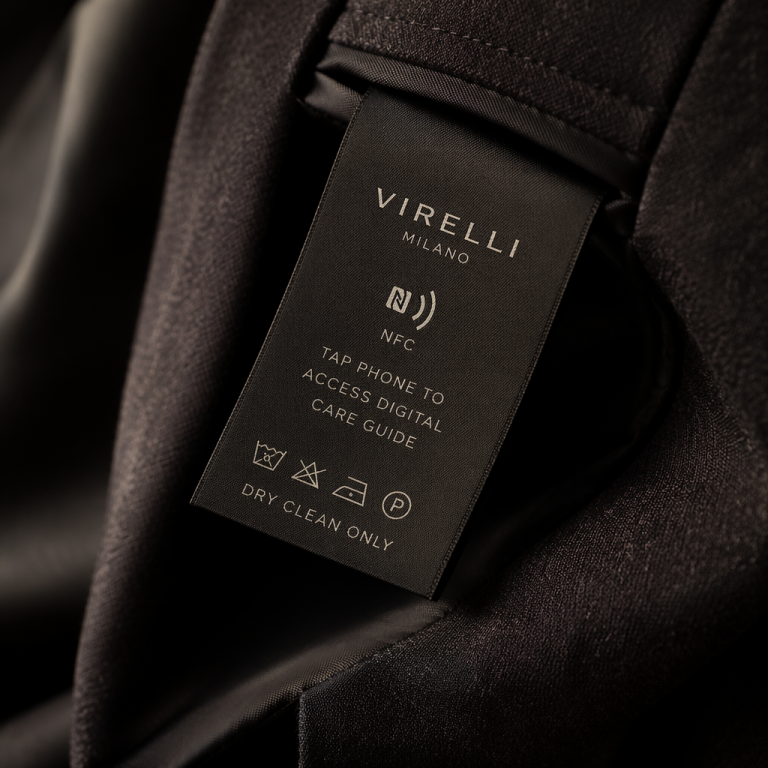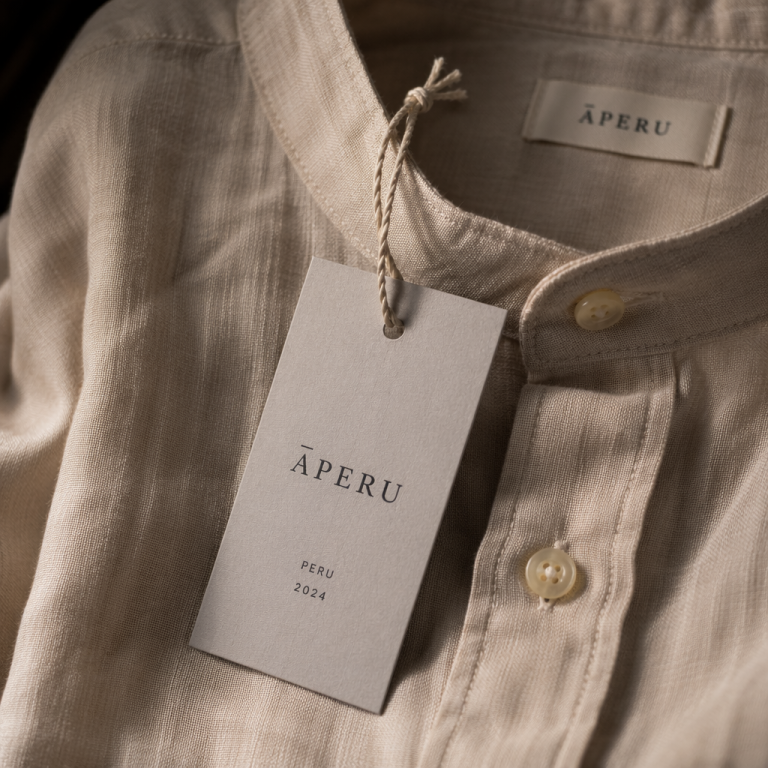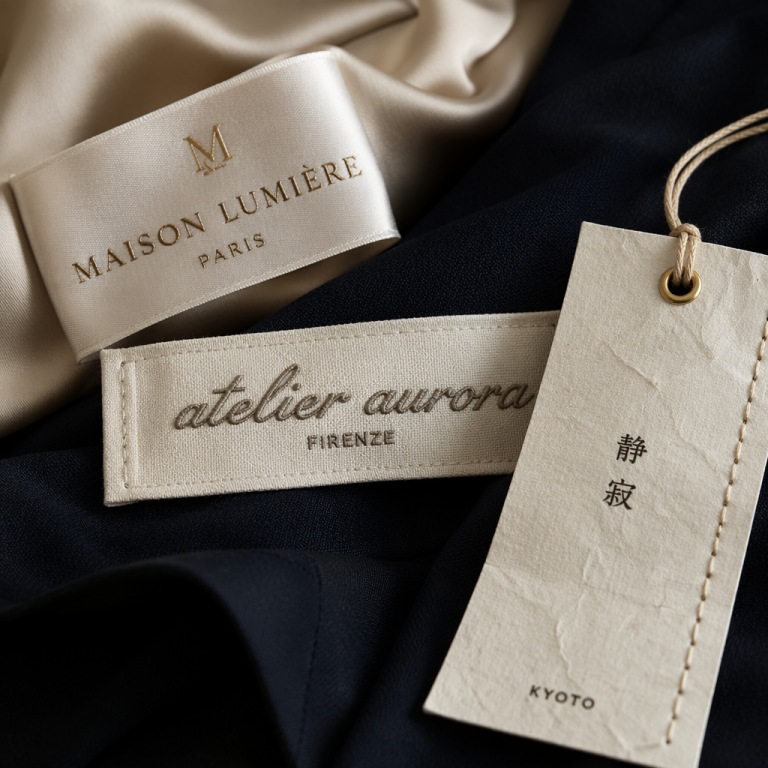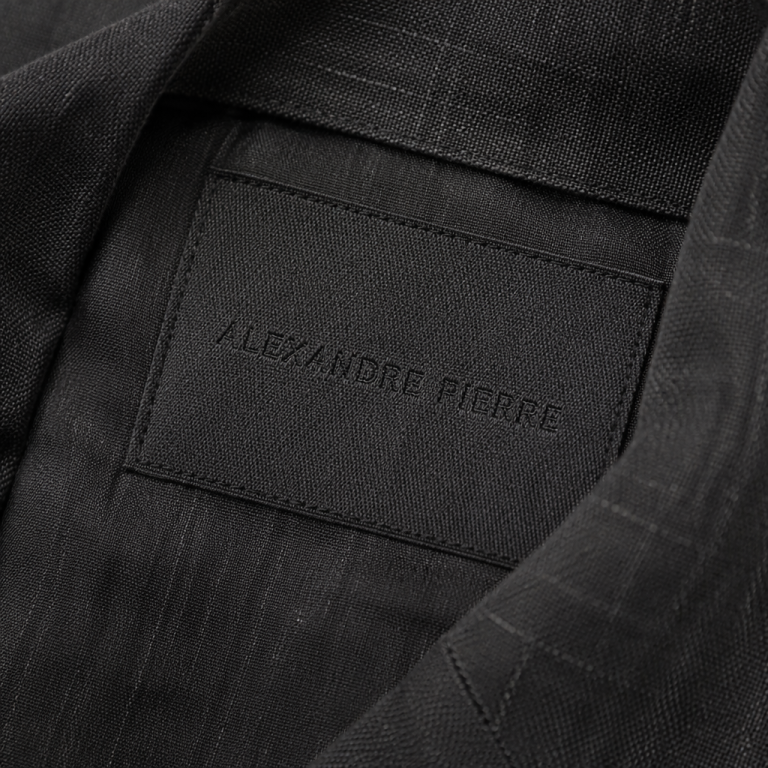
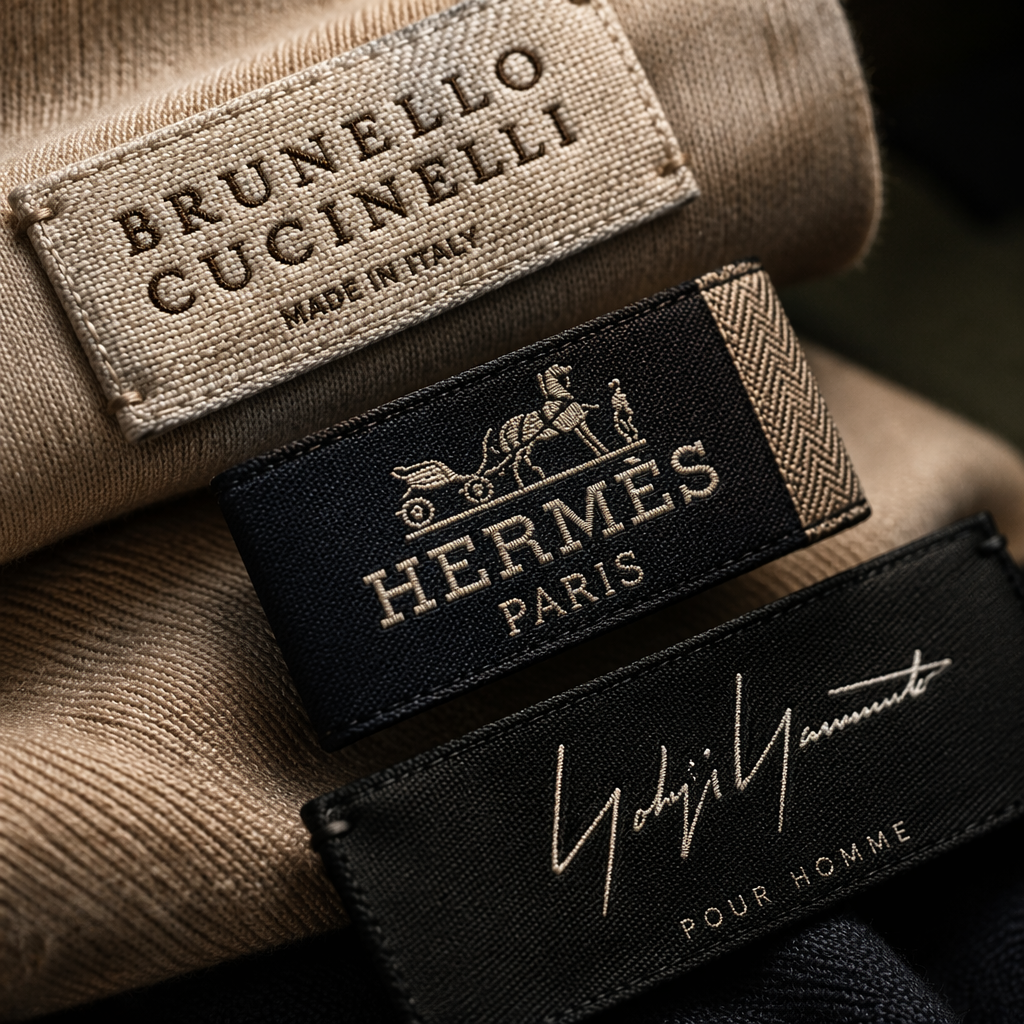
In a quiet corner of Dover Street Market in Ginza, I slipped behind a rack of deconstructed jackets and found three garments hanging side by side: a softly unstructured cashmere blazer from Brunello Cucinelli, a silk twill shirt from Hermès, and a hand-stitched cotton coat by Yohji Yamamoto. What stopped me wasn’t the drape of the Solomeo cashmere or the Hermès orange piping — it was the labels. Each told a completely different story before I’d even touched the fabric. One felt like sun-warmed leather, another like a crisp page from an archive, the third like a piece of the garment itself, humble and intentional. In that moment, I realized that the tiny rectangular tag we so often overlook is the first unspoken manifesto of a brand’s philosophy. It telegraphs where the luxury lives: in the hand, in the heritage, or in the silence of mastery.
Italy: The Hand You Can Feel
Italian luxury labels are tactile love letters. Spend ten minutes inside a Bottega Veneta boutique and you’ll notice how the brand’s signature intrecciato leather extends even to the shirt labels — soft, flexible, almost skin-like. The Italian approach to the garment tag is built around material truth. It’s not unusual to find unlined leather labels debossed with a house name, or sun-faded woven cotton that mimics the patina of a well-worn vintage find. In Italy, the label isn’t an afterthought; it’s an extension of the same artisanal process that made the sleeve.
Consider a simple Brunello Cucinelli sweater. The main label is a whisper of beige cotton, utilitarian in width, yet the thread count and weave are so intentional that the tag itself feels like a swatch of fine shirting. Flip to the care label, and you’ll often see a separate leather tab hand-stitched beside it, carrying the brand’s founding principle — “Fatto con amore in Italia” — in a serif type that mimics old-world stationery. This blend of material and message is uniquely Italian: the label celebrates the rawness of the component, not just the finished garment.
Key Italian label characteristics
- Material-first sensibility: Leather, suede, uncoated cotton, and washed canvas appear as main labels to echo the handfeel of the garment.
- Celebratory text: Phrases like “Fatto in Italia,” “Artigianale,” or “Pura Lana Vergine” are displayed with pride, often in debossed or tonal embroidery.
- Irregularities as authenticity: Slightly uneven stitching, burnished edges, or graphic fading on a tag are not defects—they signal the hand of a skilled maker. Think of Loro Piana’s “Hand Made” tags that carry the artisan’s personal stamp.
- Size and placement as narrative: Many Italian brands (Prada, Gucci) place the main label at the collar, but the real poetry is in the secondary labels at the side seam, where care symbols are interspersed with poetic lines about material origin.
France: The Code of the Atelier
If Italian labels feel like a handshake, French labels are a formal introduction. In the salons of Chanel and the ateliers of Hermès, the garment tag functions as a tiny passport — precise, archival, almost institutional. French luxury labels don’t just state provenance; they assert it. When you turn over the hem of a Hermès silk blouse, the jacquard-woven label with “Hermès Paris” in its iconic carriage typeface isn’t asking to be touched — it’s asking to be read. The experience is one of controlled revelation.
I’ve spent afternoons scrutinizing labels inside vintage YSL Rive Gauche blazers and newer Celine pieces by Hedi Slimane. The French approach explores the tension between opacity and disclosure. The information is impeccably organized: composition, country of origin, model number, and often a cryptic atelier code — all beautifully typeset in a font size that forces you to lean in. There’s a discipline here that mirrors the couture tradition, where every stitch is documented and every toile is archived. French labels don’t celebrate the rawness of material so much as the mastery of it.
Signature French label details
- Archival precision: Expect model numbers (“1A1234”), lot references, and atelier insignias, especially inside heritage houses like Dior and Givenchy.
- Jacquard dominance: Main labels are almost always dense jacquard weaves with high thread counts, giving them a stiff, substantial hand that resists age. Saint Laurent’s black-on-black woven labels are a masterclass in this.
- “Made in France” as a minimalist declaration: It rarely comes with explanation; it’s a simple line of text, often in French (“Fabriqué en France”), letting the maison’s reputation do the talking.
- Contrast control: Louis Vuitton’s leather goods tags are famously loud, but inside its ready-to-wear, the label is often a grey-on-grey embroidered tab — discreet luxury that whispers rather than shouts.
Japan: The Whisper in the Seam
The first Comme des Garçons coat I bought came with a label that felt like a scrap of hospital cotton — unbleached, raw-edged, and screen-printed with black ink that bled ever so slightly into the fibers. There was no plastic sheen, no gold foil. It was so perfectly aligned with the garment’s concept of imperfection that I kept the coat unbuttoned just to glimpse it. Japanese luxury labels operate on a philosophy of anonymous mastery. They are anti-spectacle. The quieter the label, the louder the craftsmanship.
When you examine garments from Issey Miyake, Yohji Yamamoto, or Visvim, you notice that the label isn’t designed to be found — it’s designed to be discovered. A Miyake Pleats Please piece often hides its label in a side pocket, printed on a swatch of the same plissé fabric, so it becomes one with the garment. Visvim’s Hiroki Nakamura takes this even further: his labels may be handmade paper tags stitched with silk thread, or natural leather tabs that will darken with age. The Japanese ethos is to treat the label not as a brand billboard but as a quiet seal of the maker’s intent. Information is dense yet minimal — often “Made in Japan” alone, in a typeface so understated it nearly vanishes.
How Japanese labels communicate differently
- Material integration: Labels are frequently made from the same fabric as the garment (cotton canvas, indigo-dyed cloth, woven silk) so they feel like an organic part of the whole.
- Honorific silence: Instead of flowery phrases, many designers use only “Made in Japan”